Thursday, April 2, 2020

Malaysia RM60 and RM600 Commemorative Banknote


One the 14th December 2017, Bank Negara Malaysia had announce that they will issue the RM60 and RM600 commemorative banknote in conjunction with the 60th Anniversary of the Signing of the Federation of Malaya Independence Agreement, this issuing is making the headlines of every local numismatic collector, for those who may not know the history, issuing quantity and specification of this banknotes, you may visit the link here for more details.

And the RM600 banknotes obtain the crown of largest banknote in the world by the Guinness World Records, here is the link on the Guinness World Record website.

And for those who like the banknotes to be certified and grade by PMG, you may found their grading point population as below link,

For RM60 PMG grading population, the link is here.

For RM600 PMG grading population, the link is here.

And last but not least, there are 3 in 1 uncut sheet for RM60, which the PMG grading population is under the column of 57a at the link for the RM60 PMG grading population link.


Wednesday, April 1, 2020

Is it a last million number error note or a specimen note?


In the coming Monetarium Auction to be carry out on 4th April 2020, under the lot 548, is featuring a piece of Malaysia 6th series ND (1986) One Ringgit, with the prefix serial number CC0000000, those who have the interest on this note can found the bidding link here.

The question is now we consider this piece of banknote a specimen banknote or a last million number error banknote?

Normally a specimen banknote have a specimen mark on the note, and normally it will carry the first prefix in this case may be AA, but CC prefix is consider the middle prefix, so collector are guessing if this consider the last million serial number that print in error without the number "1" in it?

This may be very interesting topic to study but at the moment I don't have any idea or good answer for this question, those who interested on this banknote can click the link in first paragraph to proceed for the bidding, any you may browse other item in that auction to check if there are any collectable items suit your interest.

Tuesday, March 31, 2020

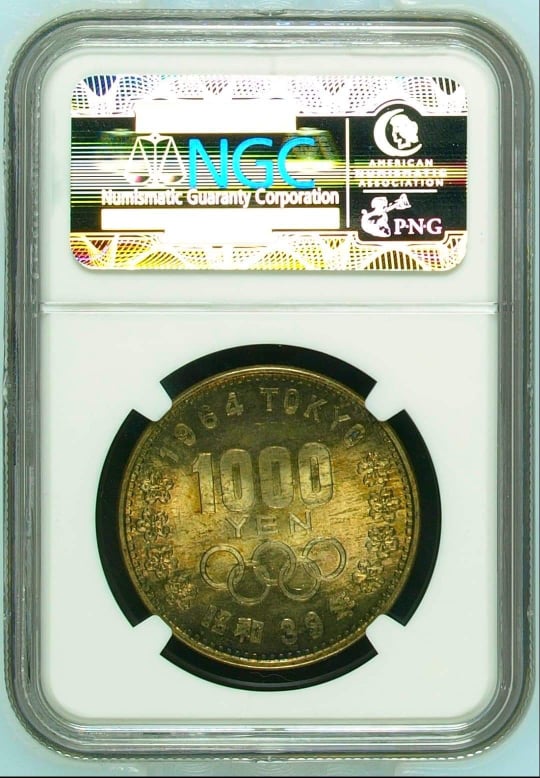
1964 Tokyo Olympic Commemorative Coin


Tokyo is the city to be hosting the 2020 summer Olympic Games in coming July, due to the Covid-19 Pandemic which strike around the would, the IOC had decided to postpone the game to 23rd July 2021 and the Paralympic will be postpone to 24th August 2021, the game will be still name as Tokyo 2020.

This is the second time Tokyo to host the prestige summer Olympic Games, they first hosted it in the year 1964, in this post I would like to share the commemorative coin issued in conjunction for the 1964 Tokyo Olympic Games.

Details and specification of the coin can be found in the link here.


British Trade Dollar


British Trade Dollar coin is one of the popular collection item for Malaysia Numismatic coin collector, for the newbies which to know more about the basic information on this coin, below are some useful link,

The link below have the basic specification and it's population base on years,

https://en.numista.com/catalogue/pieces8472.html

And the link below is the NGC website which have some basic coin price reference,

https://www.ngccoin.com/price-guide/world/great-britain-dollar-km-t5-1895-1935-cuid-1202269-duid-1334864

For some basic introduction on the history of this coin, here some paragraph that copy from Wikipedia,

With the extension of British trading interests in the East, especially after the founding of Singapore in 1819 and Hong Kong in 1842, it became necessary to produce a special Dollar so as to remove the reliance of a British Colony upon the various foreign coins then in circulation.
"China trade silver dollars" were a direct result of the First (1839–1842) and Second Opium War (1856–1860), which broke out when Chinese authorities tried to stop Britain from smuggling opium into the country. The loser, China, had to open up a number of ports to British trade and residence, and cede Hong Kong to Britain. In the decades that followed, merchants and adventurers flocked to these areas, and international trade flourished. Foreign banks were established and large silver coins from all over the world began arriving to pay for tea, silk and Chinese porcelain to be shipped abroad. These .900 fine silver trade dollars were then circulated throughout China, where they were readily accepted as a medium of exchange. The British Trade Dollars, minted exclusively for use in the Far East, depict Britannia standing on shore, holding a trident in one hand and balancing a British shield in the other, with a merchant ship under full sail in the background. On the reverse is an arabesque design with the Chinese symbol for longevity in the center, and the denomination in two languages - Chinese and Jawi Malay.
The British Trade Dollar was designed by George William De Saulles and minted from 1895 for Hong Kong and the Straits Settlements. But after the Straits dollar was introduced to the Straits Settlements in 1903, it became exclusively a Hong Kong coin produced until 1935. Those with the mint mark "B" were produced at the Bombay Mint; others, marked "C", were struck in Calcutta. Those with no mint mark were produced in London. The mint mark "C" can be found in the ground between the left foot of Britannia and the base of the shield, while the mint mark "B" is located in the center prong of the trident. The 1921-B dollar was struck but never released for circulation, and only a limited number of 1934-B and 1935-B coins were released.
In some cases, the date on an already manufactured coin die was altered. As this could not be done without leaving a trace of the former date, some coins show traces of an older date below the clearly visible date. These include 1897-B over 1896-B, 1900-B over 1894-B, 1901-B over 1900-B, 1909-B over 1908-B, 1904-B over 1898-B, 1903-B over 1902-B, 1908-B over 1903-B, 1904-B over 1903-B, 1929-B over 1901-B, 1908-B over 1907-B, and 1910-B over 1900-B.
The British Trade Dollar was demonetized on 1 August 1937.

As those are very basic information to start on studying this coin, by going further, you may found the road is very interesting by learning their variant, the technic, knowledge and experience to differentiate the counterfeit and genuine coin and many other elements waiting for you to discover.

Photo source is from Facebook numismatic group.

Wednesday, March 25, 2020

Malaysia First Series of One Ringgit banknotes

On the 15th March 2020, PMG Facebook Page featuring their note of the day with this piece of Malaysia 1 Ringgit banknotes, in their introduction of this banknotes, they call it as the first series one ringgit banknotes for Malaysia as below,

Note of the Day: This beautifully printed and preserved Malaysia Undated (1981-83) First Series 1 Ringgit is graded PMG 70 Gem Uncirculated EPQ ★. The series started in 1967 and was withdrawn in 1987. It has a portrait of the first head of state of the Federation of Malaya, Tuanku Abdul Rahman. 

PMG is putting the 1967 to 1983 banknotes as first series may be due to the designed but in local banknotes guidebook catalogue, we may find they separate it to 4 series, which the 1st series is from 1967 to 1972, 2nd series is from 1972 to 1976, 3rd series is from 1976-1981, and 4th series is from 1981 to 1983, and PMG actually have them separate in the label which you found the Pick# serial number and ND (years of issue) is different for this 4 series.


1967-1972 have the old spelling of "DI-PERLAKUKAN" and "GABENOR". Signed by Tun Ismail Mohd. Ali. Engraved and Printed by Bradbury, Winkinson & Co. Ltd., England.

1972-1976 is having the same signature as the 1967-1972 issue but with new spelling of "DIPERLAKUKAN" and "GABENUR" with same engraved and printing company.

1976-1981 with same signature, same printing company, with new design and spelling with latent image (guilloche) at bottom left corner and the digit value appears on the left hand corner.

And the 1981-1983 which the photo is showed in this post, is basically similar to the 1976-1981 version with the changed of the Governor Tan Sri Dato's Abd Aziz Haji Taha.


Wednesday, January 15, 2020

1934 Straits Settlements One Dollar

Straits Settlements Bank Notes is one of the Malaysia Numismatic collector favorite theme of collection, PMG had on 11th January 2020 select the 1934 Strait Settlement One Dollar to become their "Note of the day" post on that day. Here is how PMG introduce this note,

Note of the Day: The Straits Settlements were British territories in Southeast Asia, primarily Malaysia, roughly between 1824 until the Japanese invaded in World War II. The Malayan tiger depicted on the back of this $1 note, a subspecies unique to the Malay Peninsula, is one of the smallest tigers in the world and is classified as critically endangered, according to the World Wildlife Fund. #caturday #tigers #papermoney#banknotes #numismatics

Source from PMG Facebook Page.


Sunday, January 5, 2020

MALAYA PATTERN BANKNOTES


In the on-going Bank Negara Sasana Kijang Musuem exhibition, featuring the theme of "The 60-Year Journey of Bank Negara", the interesting pattern banknotes can be found in this exhibition.

During Bank Negara in their project to issue the first series of Malaya banknotes, there are some proposed designs from the company wish to involve in the project, one of the company from England, Bradbury, Wilkinson & Co., Ltd. New Malden Surrey, had proposed the designs as shown in the below photo, which they did not make the final cut to become official design of our first series banknotes, how do you think of this design?